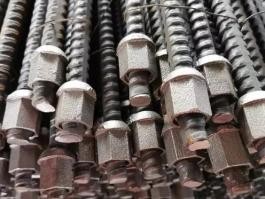
Los diámetros de los pernos de anclaje varían de 6 a 400 mm.
Anchor bolts are tension members that penetrate into the rock mass, connecting engineering structures to stable strata to enhance the overall stability of the rock or slope. They are widely used in support engineering such as mine tunnels, tunnels, slopes, and underground rooms. Background Anchor bolts (English: Bolt orting) are one of the most basic and critical support forms in modern geotechnical engineering. They originated in the early 20th century's underground mining industry, where were used to solve the problem of instability in tunnel surrounding rock. With technological development, their application has expanded to tunnels, bridges, slopes, dams, and even the protection ofrotto art. Anchor bolts can not only support structures passively but also actively reinforce rock and soil, forming a "rock mass anchor bolt" composite load-bearing system significantly improving engineering safety. Core components and working principle of anchor bolts Anchor bolts usually consist of three parts: Anchor section: The part that penetrates into the stable stratum, transmitting tension through cement grout or other bonding materials to the deep layer. Free section: Located in the non-stable area, allowing displacement during tensioning, facilitates the application of pre-stress. Exposed end (including the base plate and nut): Used for tensioning and locking, and evenly transmitting the load to the surface of surrounding rock. Its core mechanisms include: Suspension effect: Suspending the unstable rock stratum on the deep stable rock mass; Composite beam/arch: Making multiple rock strata work together under force, forming an overall structure; Pressed reinforcement effect: Improving the stress state of the surrounding rock through pre-stress, friction and self-stability capacity.
Contact:zhang sir
Phone:+8618660802011
E-mail:@163.com
Add:shandongxinyaheng

 zhang xiao
 123456